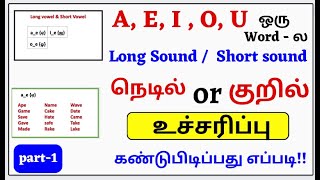
English Vowels Meaning In Tamil: A Guide for Parents and Teachers
Understanding the relationship between English vowels and their Tamil equivalents is essential for early‑year educators, phonics coaches, and parents who want to build a strong foundation in both languages. This article explains the five English vowel letters, their short and long sounds, and how each sound is represented in Tamil. The information is especially useful for preschool teaching, phonics programs, and bilingual literacy activities.
Why Compare English Vowels with Tamil?
English and Tamil share a common need for vowel sounds, but the way each language categorises them differs. In English, vowel length (short vs. long) changes meaning, while Tamil uses a distinct set of letters to capture both short and long vowel qualities. By linking the two systems, teachers can:
- Help children recognise the same sound patterns in two scripts.
- Reduce confusion when a child hears a sound in English and looks for it in Tamil.
- Strengthen phonemic awareness, a key predictor of reading success.
The Five English Vowel Letters
English vowel letters are A, E, I, O, U. Each can produce a short sound (as in “cat”) or a long sound (as in “cake”). Below is a side‑by‑side comparison with Tamil vowel symbols.
1. Letter A – Short and Long
Short A ( /æ/ ) – Example: “cat”. In Tamil, this sound is written as அ (a).
Long A ( /eɪ/ ) – Example: “cake”. Tamil represents this with the diphthong ஏ (ē), which combines எ and a lengthening marker.
2. Letter E – Short and Long
Short E ( /ɛ/ ) – Example: “pen”. Tamil equivalent: எ (e).
Long E ( /iː/ ) – Example: “see”. Tamil uses ஈ (ī), a prolonged version of இ.
3. Letter I – Short and Long
Short I ( /ɪ/ ) – Example: “pin”. Tamil representation: இ (i).
Long I ( /aɪ/ ) – Example: “kite”. Tamil writes this sound as ஐ (ai), a combination of அ and இ.
4. Letter O – Short and Long
Short O ( /ɒ/ or /ɑ/ ) – Example: “pot”. Tamil counterpart: ஒ