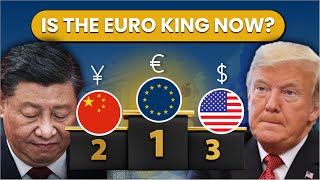
Understanding the Euro and Dollar Difference
For anyone traveling abroad or investing in international markets, a common question arises: why isn't $1 the same as €1? While both the United States Dollar (USD) and the Euro (EUR) are among the most powerful currencies in the global economy, they operate under different regulatory frameworks, represent different geopolitical entities, and fluctuate in value based on market demand.
Understanding the difference between the Euro and the Dollar requires a look at their origins, their roles as reserve currencies, and the specific financial terminology that often confuses beginners.
What is the US Dollar?
The US Dollar is the official currency of the United States and serves as the primary global reserve currency. Because the US economy is one of the largest in the world and the US Treasury market is highly liquid, most international commodities—such as oil and gold—are priced in dollars.
The value of the dollar is managed by the Federal Reserve, which adjusts interest rates to control inflation and stabilize the economy. When the Federal Reserve raises interest rates, the dollar often becomes more attractive to investors, increasing its value relative to other currencies.
What is the Euro?
The Euro is the official currency of the Eurozone, a monetary union of 20 European Union (EU) member states. Unlike the dollar, which represents a single nation, the Euro represents a collective of diverse economies.
The Euro is managed by the European Central Bank (ECB). The ECB's primary mandate is to maintain price stability across the Eurozone. Because the Euro is used by so many different countries, its value is influenced by the combined economic health of its member states, ranging from Germany and France to smaller economies like Malta or Estonia.
Key Differences in Value and Exchange Rates
The "difference" most people refer to is the exchange rate. The exchange rate is the price of one currency in terms of another. It is not static; it changes every second based on the foreign exchange market (Forex).
- Market Demand: If global investors believe the European economy is growing faster than the US economy, they may buy more Euros, driving the price up.
- Interest Rates: If the ECB offers higher interest rates than the Federal Reserve, investors may shift their capital into Euro-denominated assets, increasing the Euro's value.
- Geopolitical Stability: Political instability in the EU or the US can cause investors to flee to the "safer" of the two currencies.
Clearing Up Confusion: What are Eurodollars?
A common point of confusion when researching the Euro and Dollar difference is the term "Eurodollar." Despite the name, a Eurodollar has nothing to do with the Euro currency used in Europe.
Simply put, the term Eurodollar describes US dollars held in banks outside of the United States. These are essentially US dollar-denominated deposits at foreign banks. They are called "Eurodollars" because this practice originally began in Europe, but today, Eurodollars can be held in banks anywhere in the world, including Asia. This market is crucial for international trade and provides liquidity to the global financial system independently of US domestic regulations.
Which Currency is "Stronger"?
In financial terms, "strength" can be interpreted in two ways: nominal value and economic influence.
- Nominal Value: Historically, the Euro has often held a higher nominal value than the Dollar (meaning 1 Euro is worth more than 1 Dollar). However, there have been periods where they reached "parity," meaning 1 Euro equaled exactly 1 Dollar.
- Economic Influence: The US Dollar is generally considered the more influential currency due to its status as the dominant reserve currency. Most central banks hold larger reserves of USD than EUR, and the USD is used more frequently in global trade settlements.
Summary of Comparison
To summarize the primary differences: