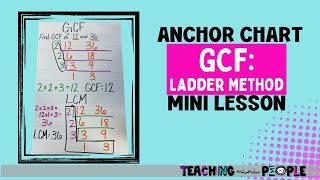
What Is a Greatest Common Factor Anchor Chart?
An anchor chart is a visual reference that teachers display in the classroom to reinforce a concept. A Greatest Common Factor (GCF) anchor chart specifically outlines the steps and strategies for finding the largest number that divides two or more integers without a remainder. By keeping this chart visible, students can quickly recall the process during independent work, quizzes, or group activities.
Why a GCF Anchor Chart Benefits 6th‑Grade Learners
Sixth‑grade mathematics introduces factoring, simplifying fractions, and solving equations that rely on the GCF. A well‑designed anchor chart helps students:
- Visualize the procedure, reducing the cognitive load of remembering each step.
- Develop independent problem‑solving skills by providing a quick reference.
- Strengthen mathematical vocabulary such as “prime factorization,” “common factors,” and “greatest common divisor.”
- Encourage collaborative discussion as learners point to the chart while explaining their reasoning.
Key Components of an Effective GCF Anchor Chart
1. Title and Purpose
Place a clear heading—“Greatest Common Factor Anchor Chart”—at the top. Include a brief statement of purpose, for example: “Use this chart to find the largest common factor of any set of whole numbers.”
2. Step‑by‑Step Procedure
Present the steps in a numbered list so students can follow them in order:
- List the factors of each number.
- Identify common factors shared by all numbers.
- Circle the greatest of the common factors—the GCF.
3. Visual Aids
Include a small factor tree or a table that shows how to break numbers into prime factors. Visuals help students see why the GCF is the product of the lowest powers of common primes.
4. Shortcut Methods
Provide quick alternatives for larger numbers:
- Prime factorization method: Multiply the lowest powers of all primes that appear in every factorization.
- Division method (Euclidean algorithm): Repeatedly divide the larger number by the smaller until the remainder is zero; the last non‑zero divisor is the GCF.
5. Real‑World Examples
Show at least two classroom‑level problems, such as simplifying 24/36 or arranging garden beds in equal rows, and solve them using the chart steps. This demonstrates the relevance of the GCF beyond abstract numbers.
How to Create Your Own GCF Anchor Chart
Follow these practical steps to design a chart that aligns with your classroom style:
- Gather materials: Large poster board, markers in contrasting colors, rulers, and printed factor trees.
- Draft a layout