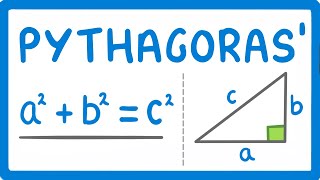
Understanding the Pythagorean Theorem Using Coordinates
The Pythagorean theorem is a cornerstone of geometry, stating that in a right‑angled triangle the sum of the squares of the two legs equals the square of the hypotenuse (a² + b² = c²). When the vertices of a triangle are placed on a coordinate plane, the theorem becomes a powerful tool for finding distances, verifying right angles, and solving real‑world problems.
Why Use Coordinates?
Coordinates give every point a precise location expressed as an ordered pair (x, y). By converting a geometric figure into a set of points, you can apply algebraic formulas directly, eliminating the need for measuring tools or visual estimation. This approach is especially useful in:
- Computer graphics and game design.
- Physics problems involving displacement.
- Standardized test questions that provide points rather than drawn figures.
Deriving the Distance Formula from the Pythagorean Theorem
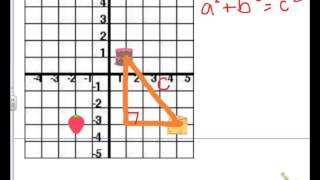
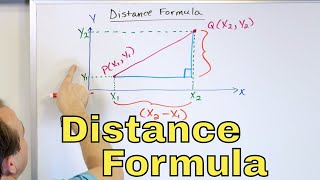
Consider two points P₁(x₁, y₁) and P₂(x₂, y₂). Draw a right triangle where the horizontal leg measures |x₂ − x₁| and the vertical leg measures |y₂ − y₁|. Applying the theorem:
[(x₂ − x₁)²] + [(y₂ − y₁)²] = d²
Solving for d (the distance between the points) gives the classic distance formula:
d = √[(x₂ − x₁)² + (y₂ − y₁)²]
This equation is the direct result of using the Pythagorean theorem on a coordinate grid.
Step‑by‑Step Guide to Calculating a Line Segment Length
- Identify the coordinates of the two endpoints. Example: A(3, 4) and B(7, 1).
- Find the differences in the x‑ and y‑values: Δx = 7 − 3 = 4, Δy = 1 − 4 = ‑3.
- Square each difference: Δx² = 16, Δy² = 9.
- Add the squares: 16 + 9 = 25.
- Take the square root of the sum: √25 = 5. The length of segment AB is 5 units.
This quick guide mirrors the explanation found in many free online lessons, such as those on Khan Academy, where you can practice the method and save your progress at no cost.
Using Coordinates to Verify a Right Triangle
If you have three points—