Introduction to Spanish Question Words
Mastering Spanish question words is the first step toward asking clear, natural questions in any conversation. Whether you’re a beginner or looking to polish your skills, knowing how to use words like qué, quién, and cómo will open up a world of communication possibilities.
In this class we will review the most common question words, explore their nuances, and practice them with real‑life examples. If you want to deepen your learning, JOIN OUR COMMUNITY HERE – as a member of our community, you get exclusive exercises, live Q&A sessions, and a supportive network of Spanish learners.
The Core Spanish Question Words
Spanish question words are often referred to as pronombres interrogativos. Below is a quick reference guide to the most frequently used ones.
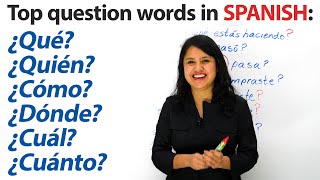
- ¿Qué? – “What?” – used to ask for information or clarification.
- ¿Quién? – “Who?” – for identifying people.
- ¿Quiénes? – plural form of “who.”
- ¿Cuál? – “Which?” – used for choices.
- ¿Cuáles? – plural “which.”
- ¿Cuánto? – “How much?” – for quantities.
- ¿Cuántos? – plural “how many.”
- ¿Dónde? – “Where?” – location questions.
- ¿Cuándo? – “When?” – time questions.
- ¿Por qué? – “Why?” – asks for reasons.
- ¿Cómo? – “How?” – methods or states.
- ¿Para qué? – “For what purpose?”
Why Accents Matter
Spanish uses accents to distinguish meaning and grammatical function. For example, por qué (two separate words with an accent on “qué”) means “why,” while porque (a single word without an accent) means “because.” In this video I go over LEARN THE DIFFERENCE BETWEEN POR QUÉ AND PORQUE!! to help you avoid common mistakes.
Understanding the Difference Between Por Qué and Porque
Both words are related but serve different purposes. Use the accent when you’re forming a question:
- ¿Por qué estás triste? – “Why are you sad?”
- El clima porque



![Learn Spanish Question Words [Asking Information Questions]](https://i.ytimg.com/vi/MH2GSRh-5Wk/mqdefault.jpg)


![Spanish Question Words Practice [Spanish Quiz]](https://i.ytimg.com/vi/h77YaGVTWAM/mqdefault.jpg)
